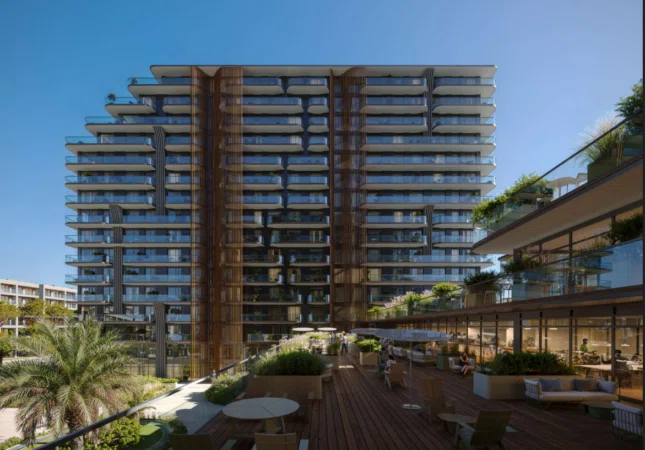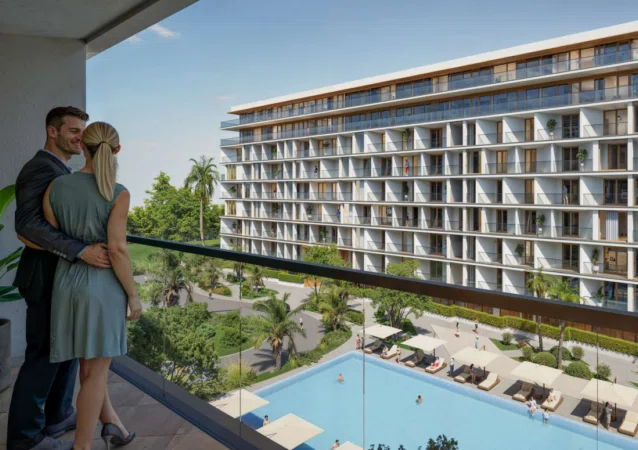
Object typeResidential
Completion dateQ4 2028
DeveloperNardaran Invest MMC
Total areafrom 46 m² to 164 m²
Down Payment30%
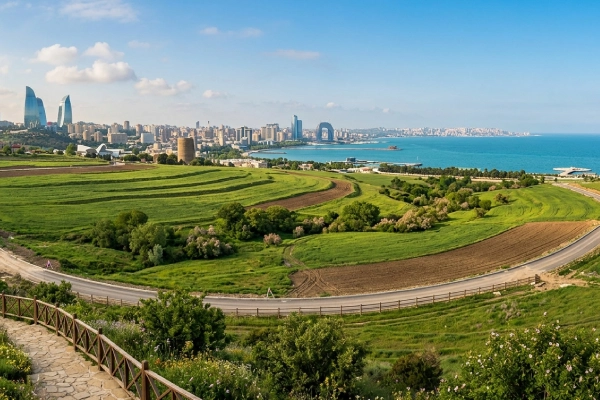
Baku's land market remains the fastest-growing segment of real estate in the region. In July 2026, the median land price reached approximately $9,630 per sotka, while the AQP index rose 22.8% relative to the April baseline.
Residential property prices are also rising steadily, but at a slower pace. In August, the median price of a new-build apartment stood at approximately $1,630 per sq. m — 5% above December 2025. The secondary market saw growth of 4.2%, and Baku's overall real estate index increased by 3.9%.
One of the primary drivers is the combination of limited supply and strong demand from investors and developers. ABB Bank (Azərbaycan Beynəlxalq Bankı), in its H1 2026 Baku market research, notes that land price growth was more pronounced than in other segments. Plots in areas with high development potential and limited buildable zones are particularly sought after, as land is viewed simultaneously as an investment asset and a construction resource.
Price is shaped by more than just location. According to the Azerbaijan Valuers Chamber, the legal status of a plot plays a significant role. Land in central and high-potential development districts commands a premium, while large peripheral plots carry a lower per-sotka price.
This gap is clearly visible in the data. In July, the average land price was approximately $11,070 per sotka, while the median stood at around $9,630. The weighted average price was lower still, at roughly $7,220. This structure reflects the influence of high-value plots with strong development potential alongside cheaper large-scale peripheral land.
Baku's land market is far from uniform. A plot's price depends on its buildability, infrastructure, size, documentation, and the development outlook for the area.
In 2026, interest is gradually spreading beyond the most expensive central locations. ABB notes a widening geographic spread of price growth and increased buyer interest in more accessible districts. At the same time, the most attractive areas remain those where limited supply combines with strong development potential.
For investors, this means that Baku's average price growth figure tells you little about any specific plot. Land in a district with a clear development pipeline and solid documentation can have an entirely different economic profile from a same-sized plot on the periphery. Making a well-informed land purchase decision requires examining not only price growth, but also the area's development strategy, historical data, and legal status.
Rising land values are unfolding against a backdrop of active growth in the construction sector. According to the State Statistics Committee of Azerbaijan, investment in residential buildings in January–July 2026 grew 3.4% in real terms, reaching approximately $932 million at the official exchange rate.
For developers, this creates additional pressure on the economics of new projects. When land appreciates faster than completed housing, developers must offset the higher land cost through other project components, buildable area, or the future sale price.
A long-term factor influencing the land market is Baku's General Plan to 2040. It covers the entire administrative territory of the capital — 212,300 hectares — and envisions a transition from a predominantly monocentric model to a multi-centre city. The plan includes territorial zoning, development of transport and social infrastructure, utility systems, and new urban centres.
For the land market, this is particularly significant: the development of new areas could substantially increase the economic value of territories that were previously far from key business hubs and city infrastructure.
Inclusion in the General Plan does not guarantee land value growth, but it can have a meaningful impact. Real price appreciation will become visible once the plan translates into roads, engineering networks, public infrastructure, and new residential and commercial projects.
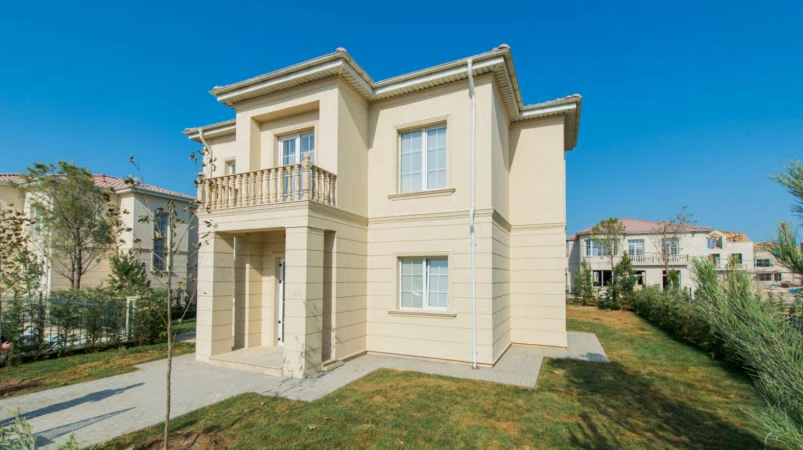
Since December 2025, new-build apartments have risen 5% in price, secondary housing by 4.2%, and individual houses by just 1%. Commercial property, by contrast, has fallen 2.3%.
ABB also notes that buyers have become more price-conscious and more selective in their choices. With demand holding steady, the market is gradually becoming more sensitive to the quality of individual offerings.
Rising land prices, therefore, do not mean that all Baku property will appreciate at the same rate.
The defining trend of 2026 is that land has become the fastest-growing segment of Baku's real estate market. The drivers are limited supply, demand from investors and developers, and the high value placed on plots in areas with strong development potential.
For investors, this represents both opportunity and risk. Strong price momentum does not make every plot a profitable purchase: documentation, buildability, size, location, and actual infrastructure development all matter.
Looking ahead, rising land costs may increase the build cost of new residential projects and put upward pressure on apartment prices. But this effect is not automatic — it depends on how quickly developers can convert expensive land into new projects, and how willing buyers are to accept higher prices.
In Baku, generating returns on investment increasingly requires evaluating not just the current price per square metre, but the economic potential of a specific area: what is already being built nearby, what infrastructure is planned, and how realistic its delivery is in the coming years.